
Carmel, Putnam County
A paver patio in Carmel, from bare lawn to a finished floor
There was no old patio to take up here. The back door opened onto grass, the ground ran the wrong way, and there was no room to get a machine in.
The short version
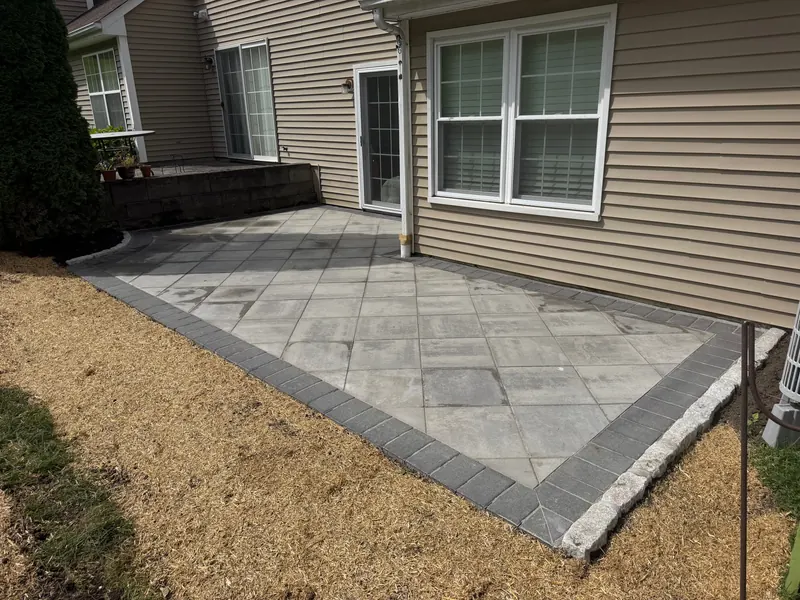
A back door that opened onto grass, ground that ran the wrong way, and no side access to get a machine in. It came out as a large-format paver floor with a charcoal border, pitched away from the house, with the lawn seeded back to the edge of it.
- Town
- Carmel, Putnam County
- Work
- Paver patio, new build on bare lawn
- Surface
- Large-format pavers, charcoal soldier-course border
- Excavation
- By hand — no machine access
What we did
A new paver patio installation in Carmel, NY, built on bare lawn against the back of the house: hand excavation with no machine access, the base graded and compacted to fall away from the building, large-format concrete pavers laid in a running pattern, a charcoal soldier-course border with a cut stone block turning the outside corner, and the disturbed ground seeded and strawed back to the paver edge.
What was there: bare lawn
No old patio to take up, and no slab underneath it. That sounds like the easy version of this job and it is not — a surface that has never existed has nothing to tell you about how the ground behaves, so everything about the build had to be read off the site rather than off whatever was there before.
The back door opened straight onto grass. In this county that means mud from October onwards, and it means the first thing anybody steps onto leaving the house is whatever the weather has done to the lawn that week.
Then we set the fall, before anything was dug
Water was the problem to solve here, and it is the decision that shaped every one that followed. On a patio built hard against a house there is one acceptable answer: the finished surface falls away from the building across its whole area, and it keeps falling once it leaves the pavers.
That gets fixed before a shovel goes in, because the pitch is built into the excavation and the base rather than corrected at the end. A patio dug flat and adjusted afterwards is a patio that holds water against a foundation, and the day you find out about it is a long time after the crew has gone home.
We dug it out by hand
The excavation in the reel above is shovels and a wheelbarrow. There is no machine in the frame, because there was no way to get one into this back yard — so everything that came out went out by barrow, and everything that went back in came the same way.
It is slower, and it is the reason the ground beside the finished patio is not churned into ruts by tracks. It also means the grade was worked to as it was dug rather than pushed roughly into shape and tidied later.
We built the base up to that grade
Compacted in lifts, to the fall that was set at the start. This is the part of a paver patio nobody ever sees and the part that decides whether it is still flat in ten winters — almost every failure in this climate traces back to the base rather than to the pavers sitting on it.
We laid the pavers, then framed them
Large-format grey pavers in a running pattern, with a charcoal soldier course framing the whole floor and a cut stone block turning the outside corner.
The dark border is not decoration. A soldier course gives the field something to be laid to, and gives the edge restraint behind it something to hold — so the perimeter, which takes every wheelbarrow, every chair leg and every freeze-thaw cycle, ends up the most tightly held part of the patio rather than the loosest.
Then we put the lawn back
Seed and straw, right up to the edge of the pavers. A patio finished to a ragged margin of bare soil is a job that is ninety-five per cent done, and the missing five per cent is the part the client looks at every day until it grows in.
Finished
Large-format pavers with a charcoal soldier course, a cut stone block turning the outside corner, and straw over fresh seed right up to the edge of the work.
Thinking about the same thing?
Tell us what you're trying to do. We'll come and look at the ground, and the estimate comes in writing.